
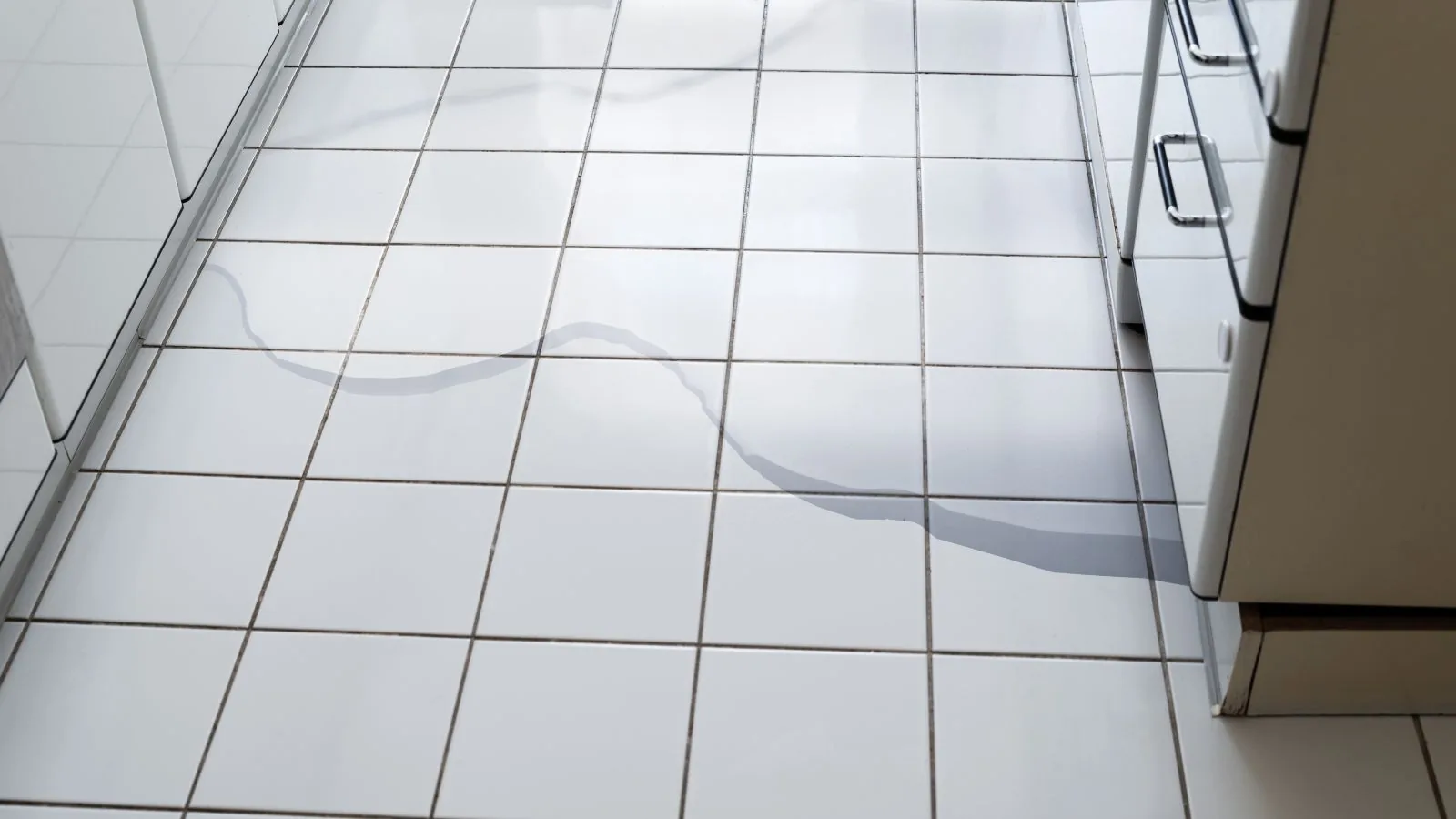
Kitchens have more water sources than any other room: a sink, a dishwasher, a refrigerator line, a garbage disposal and often a washer nearby. Shut off the supply valve under the sink or the main, then call our dispatch line. Pull items out of lower cabinets so they can dry. Call (833) 521-1033 and tell us what failed.
Kitchen water damage restoration covers cabinets, flooring, walls and the cavities behind them. A leaking dishwasher or fridge line has its own page at appliance leak water damage, and a burst supply line is explained in burst pipe water damage.
Why kitchens are tricky to dry
Cabinets sit on toe kicks that trap water, and the space behind them is hard to reach. Particleboard cabinet bases swell when they get wet and rarely return to shape. Solid wood and plywood hold up better.
Flooring also matters. Water can run under cabinets and appliances, and a floor that looks fine at the surface may be wet beneath.
- Under-sink supply lines and drains.
- Dishwasher hoses, gaskets and pumps.
- Refrigerator ice maker and water dispenser lines.
- Garbage disposal and faucet connections.
Cabinets, counters and floors
Cabinet boxes and toe kicks are the first parts to absorb water. If they are plywood and were wet briefly, drying in place is sometimes possible. Swollen particleboard usually has to be replaced.
Stone and laminate countertops are rarely harmed by water itself, but laminate with a particleboard core can swell at the edges. Flooring decides the next steps: tile, vinyl, laminate and hardwood each behave differently.
| Kitchen part | How water affects it | Typical outcome |
|---|---|---|
| Particleboard cabinets | Swell and weaken at the base | Often replaced |
| Plywood or solid wood cabinets | Can dry if caught quickly | Often dried in place |
| Vinyl or laminate flooring | Seams swell, water gets underneath | Lift and dry the subfloor |
| Tile | Usually fine, subfloor may be wet | Dry beneath and around |
Kitchen leak soaked the cabinets?
Shut off the supply valve and call us.
The hidden spaces
The toe kick, the cavity behind the dishwasher and the wall behind the sink can hold water for days. We open them as needed and use moisture meters and thermal imaging to find wet spots.
Drying hidden spaces early helps prevent mold. If mold is found, mold remediation explains what removal involves.
What happens after drying
Once moisture readings reach dry standards, the cabinets, flooring and drywall are repaired or replaced. Matching cabinets and flooring may take longer than the drying, so the scope and timeline are explained before repair work starts.
Keep photos of the damage and receipts. If a cabinet had to be removed to dry the wall, note which one and why.
What you can do while you wait for the crew
Empty the cabinets under the wet area, wiping items dry, so air can reach the cabinet floor. Pull rugs and anything absorbent off the floor, and open cabinet doors to help air move.
Photograph the source, the cabinet bases and the floor before you move much. Keep any failed hose or part, and write down when you found the water. That small record helps both the drying plan and any insurance conversation.
What Shapes The Cost
Kitchen losses depend heavily on cabinet material and what the water reached under and behind them.
- Cabinet materialParticleboard is more often replaced than plywood or solid wood.
- Flooring typeTile, vinyl, laminate and hardwood differ in what they can handle.
- Spread behind wallsWater in the cavity adds drying and possible drywall work.
- Appliance removalMoving a refrigerator or dishwasher adds labor.
- Rebuild and matchingReplacement cabinets and flooring are separate scope.
Sudden kitchen leaks are commonly covered, while slow leaks under sinks often are not. Ask your insurer and keep photos of the source.
Common Questions
Can wet cabinets be saved?
Sometimes. Plywood and solid wood often dry in place if caught quickly. Swollen particleboard usually cannot.
Do I have to remove the dishwasher?
Often yes, so the floor and wall behind it can be checked and dried.
How do I know if there is water behind the cabinets?
A moisture meter and thermal imaging find it. Visible signs include swelling, a musty smell and staining at the baseboard.
Kitchen restoration in our area
We serve West Chester Township, ZIP codes 45069 and 45071, and Cincinnati. If the water reached the floor, see hardwood floor water damage repair.
For the drying process, read structural drying.